Disclosure: Some links in this post are affiliate links. If you sign up through them, I may earn a commission at no extra cost to you. I only recommend platforms and tools I personally use.
What is SEO in 2026? SEO in 2026 is the process of getting your pages discovered and trusted across modern search — matching real search intent, answering fast, and proving credibility with clear structure. It’s less about keyword tricks and more about building pages that feel safe to recommend: in Google, in AI summaries, and everywhere people search for answers. Written by a full-time affiliate marketer with 13+ years of hands-on SEO experience.
Hey, it’s Scott! 👋
With all the recent changes and the drastic evolution of search engines over the past couple of years, you may be wondering what SEO looks like in 2026 and what has actually changed.
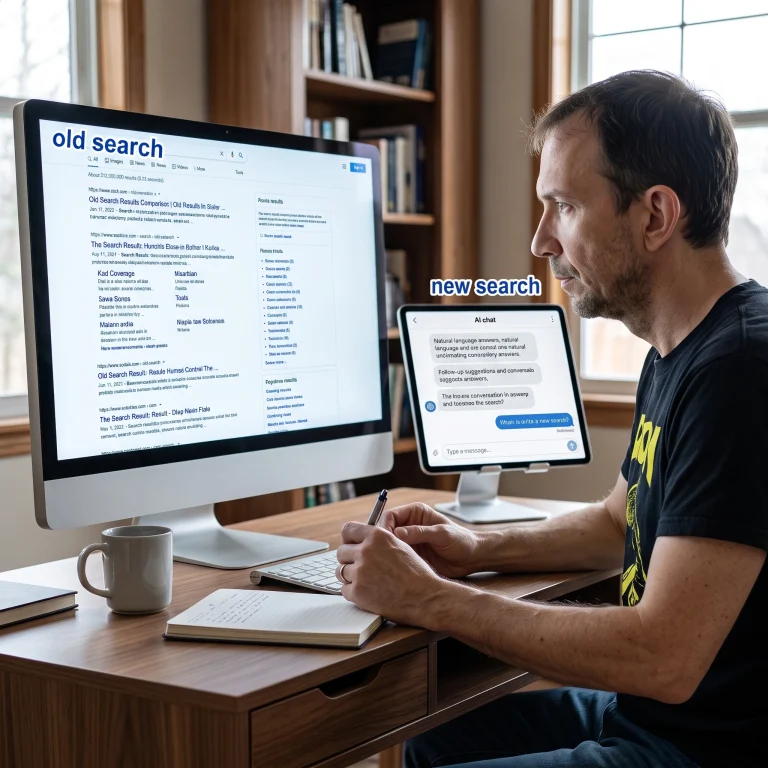
If SEO feels different lately… you’re not imagining it. Between AI overviews and people changing how they search for answers, relying only on Google just doesn’t work the way it used to.
Here’s everything that’s changed, what still works, and how to build content that wins in 2026- no BS, no theory.
🚀 Jump to any section 👇
1🤝 Why You Can Trust This Guide
4📈 How To Improve Your Rankings
5📝 7 Steps To Enhance Your Strategy
7🎯 Search Intent & Common Myths
Why You Can Trust This Guide

I’ve watched SEO evolve from “sprinkle keywords and rank” to multi-platform discovery, where Google still matters.
But AI answers, Reddit, YouTube, and creator-first content are all fighting for the same attention.
I started building websites in 2012, and I’ve had to adapt through every era SEO has thrown at us since: algorithm shifts, SERP changes, content overload.
Not to mention the 2026 reality, where people don’t always click blue links the way they used to.
I’ve lived through:
- the “easy SEO” era (when rankings felt way simpler)
- the algorithm shakeups that wiped out lazy content
- the AI content explosion (where “generic” became invisible)
- and now the trust + structure era of 2026 (where clarity wins)
So this guide isn’t theory. This is the real-world SEO system I’d give a beginner today if they told me: “I don’t want BS claims and stale info — I just want to know what works now.”
In this post, I’m going to break SEO down in plain English and show you what SEO actually means in 2026.
This includes what Google rewards now (and what it ignores), how SEO connects to GEO and AEO without the confusion.
Furthermore, how to build content that’s easy to rank, easy to skim, and easy to trust.
If you want the full backstory on how I approach traffic and content today, check out my About page here.
Alright, let’s keep it simple and get into it.
How SEO Works In 2026 (What You Need To Know)
Back in the day, you could rank with a decent keyword, a long post, and a little basic SEO.
In 2026, you’re competing with big brands with authority, Reddit and community threads.
YouTube and Shorts, AI summaries and instant answers, and a flood of “good enough” content everywhere.
Back in the day
Decent keyword → Long post → Basic SEO → Rank
Ranking in 2026
Big brands → Reddit → YouTube → AI answers → “Good enough” everywhere
So modern SEO rewards content that makes Google (and readers) feel safe choosing you.
You’re not just “trying to beat other blogs” anymore; you’re fighting for attention across a plethora of different platforms.
Search results, community answers, video platforms, and AI-generated summaries.
That means your page has to do two things at once: deliver the answer fast and prove it’s worth trusting.
What “Helpful” Means Now
Helpful in 2026 looks like this: you answer the question quickly, you show your steps (not just opinions).
You explain it in human terms, cover what they came for, and provide a next step that makes sense.
In plain English — the reader shouldn’t have to hunt for the point.
They should get value in the first minute.
And this isn’t just my take; it’s literally Google’s own playbook.
Their people-first content guidance spells out that content created primarily for people, not rankings, is what their systems are built to reward.
What “Clarity” Means Now
Clarity looks like obvious headings that match what people search for, short paragraphs (nobody wants a wall of text).
Bullet points and checklists people can scan and mini-summaries within sections so the point lands fast.
And examples that make it click instantly.
If someone scrolls fast and still understands your page, you’re doing it right.
What “Trust” Means Now (This Is The GEO Layer)
Trust looks like a real voice (not generic AI copy).
Proof where it matters, a site structure that makes sense, internal links that guide people instead of spamming them.
Never fake expertise, and stay consistent over time.
Here’s the GEO part most people miss: AI engines and modern search systems look for patterns, not just one “good post.”
If you publish consistently, keep your structure clean, and connect your content like a real library.
You become the type of site that engines feel safe summarizing, recommending, and citing.
Trust isn’t a badge. It’s a pattern.
SEO vs GEO vs AEO: What’s The Difference?
If you’re trying to grow in 2026, you need to understand how these 3 pieces fit together. SEO helps you rank in search results, GEO helps your content show up in AI-generated responses, and AEO helps you become the best direct answer. This quick table breaks it down in plain English.
| Term | What It Means | Main Goal | What It Looks Like in 2026 |
|---|---|---|---|
| SEO | Search Engine Optimization | Help your content rank in search results | Strong content, search intent, internal links, topical depth, and a page that is actually helpful |
| GEO | Generative Engine Optimization | Help your content get pulled into AI-generated answers | Clear answers, strong structure, trusted information, and content that AI can easily understand and summarize |
| AEO | Answer Engine Optimization | Help your content become the best direct answer | Fast, direct responses to questions, featured-snippet style writing, FAQ sections, and clear question-based headings |
Here’s the simple way to think about it: SEO helps your content show up in traditional search results. GEO helps your content get understood and referenced inside AI-generated answers. AEO helps your page become the clearest direct answer to a specific question.
They’re connected, but they’re not identical. SEO is still the foundation, because your content needs structure, relevance, and trust to compete in search at all. GEO builds on that by making your page easier for AI systems to interpret, summarize, and pull from. AEO tightens things further by focusing on clear question-based formatting and fast, direct answers people can find in seconds.
In other words: SEO helps you get found, GEO helps you get used by AI, and AEO helps you become the answer. In 2026, the strongest content usually does all three well instead of leaning on just one.
📚 This is Part 1 of my SEO → GEO → AEO series. This post covers the SEO foundation. Part 2 — What Is Generative Engine Optimization (GEO)? — is live, read it next. Part 3 — What Is Answer Engine Optimization (AEO)? — is live too. The full stack, all three layers, complete.
Want to see where I learned all of this?
Every SEO skill in this guide — content structure, intent matching, the hub system — I learned and still sharpen inside Wealthy Affiliate, 13 years in. The free Starter account includes 4,000 AI credits, no credit card required.
🎓 Read My 13-Year Wealthy Affiliate Review →How To Improve SEO Rankings In 2026
If SEO feels overwhelming in 2026, it’s usually because people try to do everything at once.
They’re worried about keywords, AI, backlinks, plugins, speed, schema, “Google updates”… and then they end up doing nothing consistently.
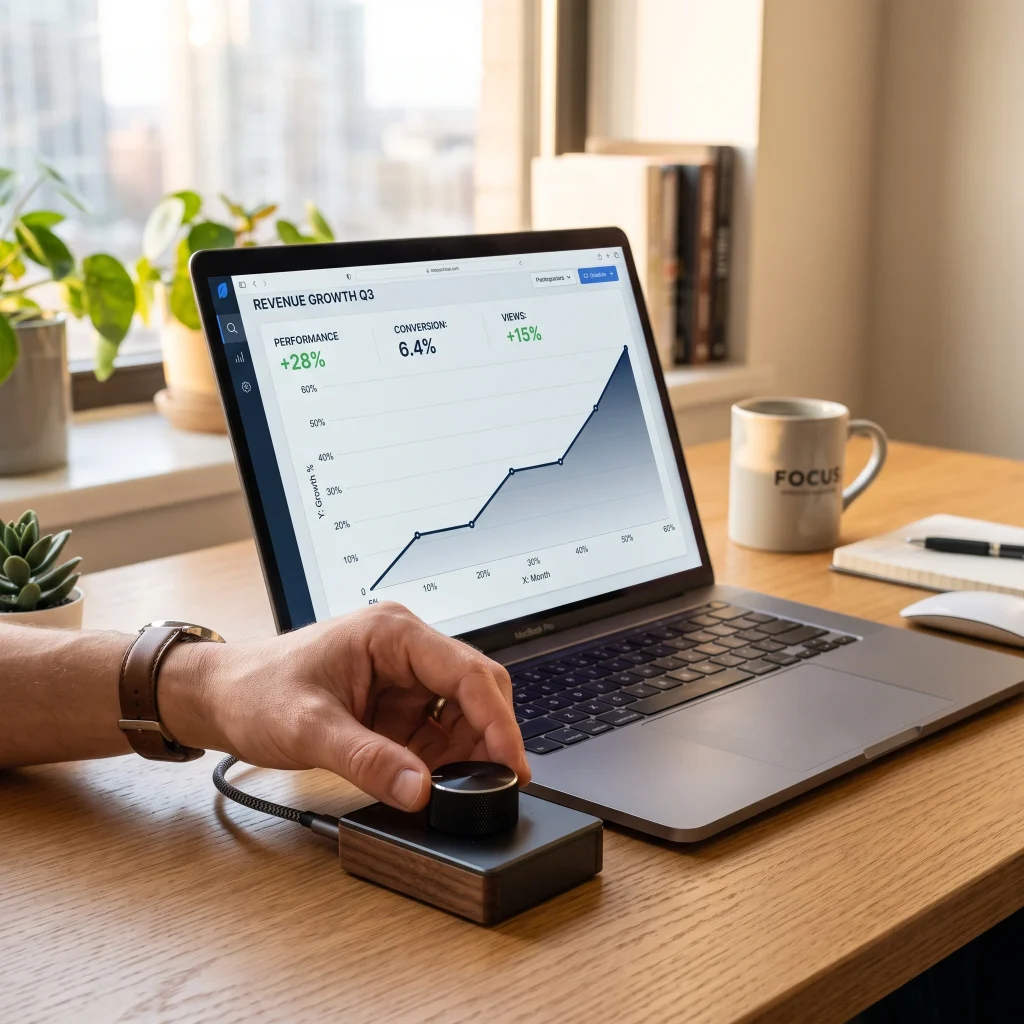
Here’s the truth: improving SEO in 2026 is mostly about doing the basics better than everyone else.
Not “more.” Better.
Three Levers That Still Move Rankings In 2026
If you focus on these, you’ll win faster than 90% of beginners:
1) Intent match (give them what they actually want)
When someone searches, they’re trying to do one thing: learn, fix, compare, buy, or choose. If your page tries to do too many things at once, it gets messy. Google can’t confidently rank it… and readers don’t stick.
2) Clarity (make it easy to understand fast)
Modern SEO favors pages that feel like a tool, a guide, a checklist, or a clean “answer page.” Not a diary entry. Your goal is to make it so someone can scroll fast and still get value.
3) Trust (make Google feel safe recommending you)
Trust signals aren’t just “about page” fluff. Trust looks like a clear author voice (“Hey, it’s Scott”), experience and proof when you have it (screenshots, what you tried, results), clean structure, and internal linking that proves topical depth (pillar → spokes → tools).
Stop Doing This If You Want Better Rankings
If you stop these, you’ll improve rankings almost automatically:
- Writing huge intros before answering the question
- Targeting 3–4 different intents in one post
- Using random H2s that don’t answer real questions
- Publishing “done” content that never gets updated
- Writing generic content that could be on any site
Create A Simple SEO Plan That Works
If you want a realistic system: Week 1 — publish or improve one “tool-style” post (this pillar format). Week 2 — publish one spoke that supports it. Week 3 — update one older post and add internal links. Week 4 — publish one spoke, add an FAQ, and tighten structure.
That’s how you build a site that compounds.
7 Steps To Enhance Your SEO Strategy In 2026
There’s a lot of “SEO advice” floating around, but most of it is either outdated or too advanced for beginners.
So here are the best practices that actually matter in 2026, without the noise.
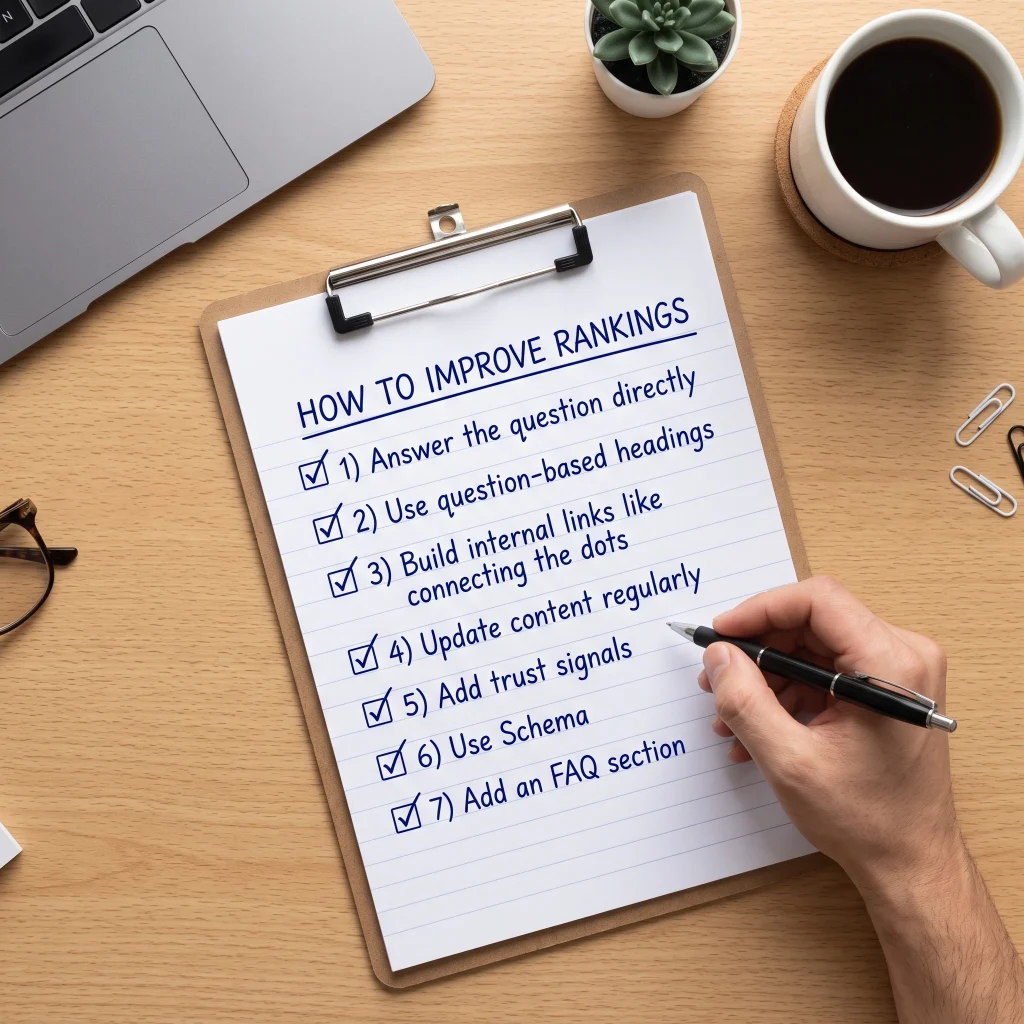
1) Write The Direct Answer Early
The first 5–10 lines should make it obvious what the post is about, who it’s for, and what problem it solves.
This helps with rankings, dwell time, AI summaries, and featured snippets.
If your post makes people hunt for the answer, they bounce.
2) Use Question-Based Headings
Headings aren’t decoration. In 2026, good headings do two jobs: help users skim, and help search engines understand your coverage.
So instead of “My SEO Thoughts”… use “Do keywords still matter in 2026?”
“What’s the difference between SEO, GEO, and AEO?”, or “How do you structure a post that ranks?”
You’re basically building mini-answers within the post.
3) Build Internal Links Like Connect The Dots
This is huge now. Google wants to see the depth of your topic, your organization, and your consistency.
So your site should feel like pillar → spokes → tools/checklists, with spokes linking back up to the pillar and sideways to related spokes.
Internal links are how Google learns what your site is “about.”
4) Update Content Regularly
SEO isn’t “publish and pray” anymore. Even a simple update block helps: an “Updated for 2026” note covering what changed.
What still works, and what beginners should focus on now.
This keeps posts relevant and can improve rankings without writing new content.
5) Add Trust Signals To Posts
Trust is a pattern. Some easy trust signals: a human presence (“Hey, it’s Scott”), a clear “who this is for.
“Add screenshots when possible, internal links that show depth, and honest disclaimers (affiliate + experience).
The payoff: generic content gets ignored, honest content gets remembered.
Posts with real trust signals grow stronger over time rather than die.
6) Use Schema Where It Makes Sense
Schema — structured data built on the shared Schema.org vocabulary — gives search engines extra context about your page
In 2026, that matters more than ever. Search is no longer just about matching keywords.
Search engines also want to understand what kind of page this is.
What does it cover, who created it, and what extra details support it?
Schema can help with clearer page understanding, richer search features, and stronger content context.
It won’t fix weak content, but it can strengthen a well-built page.
For most posts, the best options are Article, FAQ, Review, Product, or HowTo schema, when they actually fit the page.
7) Add FAQ Sections That Answer Real Questions
FAQ sections matter more than ever in 2026.
Especially when they answer questions people are actively typing into search engines or AI chat tools.
A good FAQ extends your page naturally by covering follow-up questions, beginner concerns, common objections, and related search intent.
The key is to keep the answers direct and useful.
If your FAQ is stuffed with BS answers, then it adds nothing.
If it answers real questions in plain English, it becomes another reason your page deserves to be found.
What’s The Future Of SEO In 2026 & Beyond?

SEO isn’t dead. But the “lazy SEO era” is dead.
The future of SEO in 2026 is basically this: search is now multi-platform and AI-influenced.
Google still matters, but attention is split across Reddit, YouTube, TikTok/Reels, and AI answers (Overviews, ChatGPT-style tools, Perplexity, and more).
So ranking isn’t the only goal anymore. The goal is discovery.
What Has Changed In 2026?
1) More competition than ever. There’s “good enough” content everywhere — especially AI content. So “average” becomes invisible.
2) Search results are crowded. You’re competing with AI summaries, video carousels, forums, featured snippets, and giant brands.
So your content needs to be clearer, more structured, and more trustworthy.
3) Trust matters more than word count. Longer doesn’t automatically win — useful wins.
A 1,500-word tool-style post can outrank a 4,000-word “fluff guide” because it’s easier to understand and acts like a solution.
How To Win With SEO In 2026
Even in 2026, this still wins: matching search intent, writing clearly, covering the topic fully, and adding internal links.
Consistency over time, updating posts, and being a real human with experience and an honest voice.
Where SEO Is Going & How To Stay Ahead
If you want to future-proof SEO, you build the stack: SEO gets you found in search, AEO gets you chosen as “the answer,” and GEO gets you cited and summarized by AI systems. So the future isn’t “SEO vs AI.” It’s SEO + AI-friendly structure + trust + distribution. That combo is how traffic compounds now.
SEO In 2026 Is About Search Intent, Not Just Keywords
Keywords still matter… but they’re not the boss anymore. In 2026, the real boss is intent. Ask this before you write anything: is your audience trying to learn something? Compare options? Buy? Fix something? Get a quick answer? If your page doesn’t match intent, you won’t win — even if you technically rank.
The Quick Intent Map
- Informational: “What is SEO in 2026?”
- How-to: “How to do on-page SEO.”
- Comparison: “Yoast vs RankMath”
- Buyer: “Best keyword tool for beginners.”
Match the format to the intent. That one move fixes a lot of “why is this not ranking?” pain.
Common Myths About SEO In 2026
- “SEO is dead.” No. Bad SEO is dead.
- “You just need AI content.” AI helps, but generic content doesn’t win long-term. Even Google’s own AI-content guidance says the same thing: quality and E-E-A-T matter regardless of how content gets produced.
- “Backlinks are the only thing that matters.” Links help, but they don’t fix weak intent + weak content.
- “Longer content always wins.” Useful wins. Sometimes shorter is better.
- “You need to post every day.” Consistency matters, but structure + usefulness matters more.
Create A Content Hub System In 2026
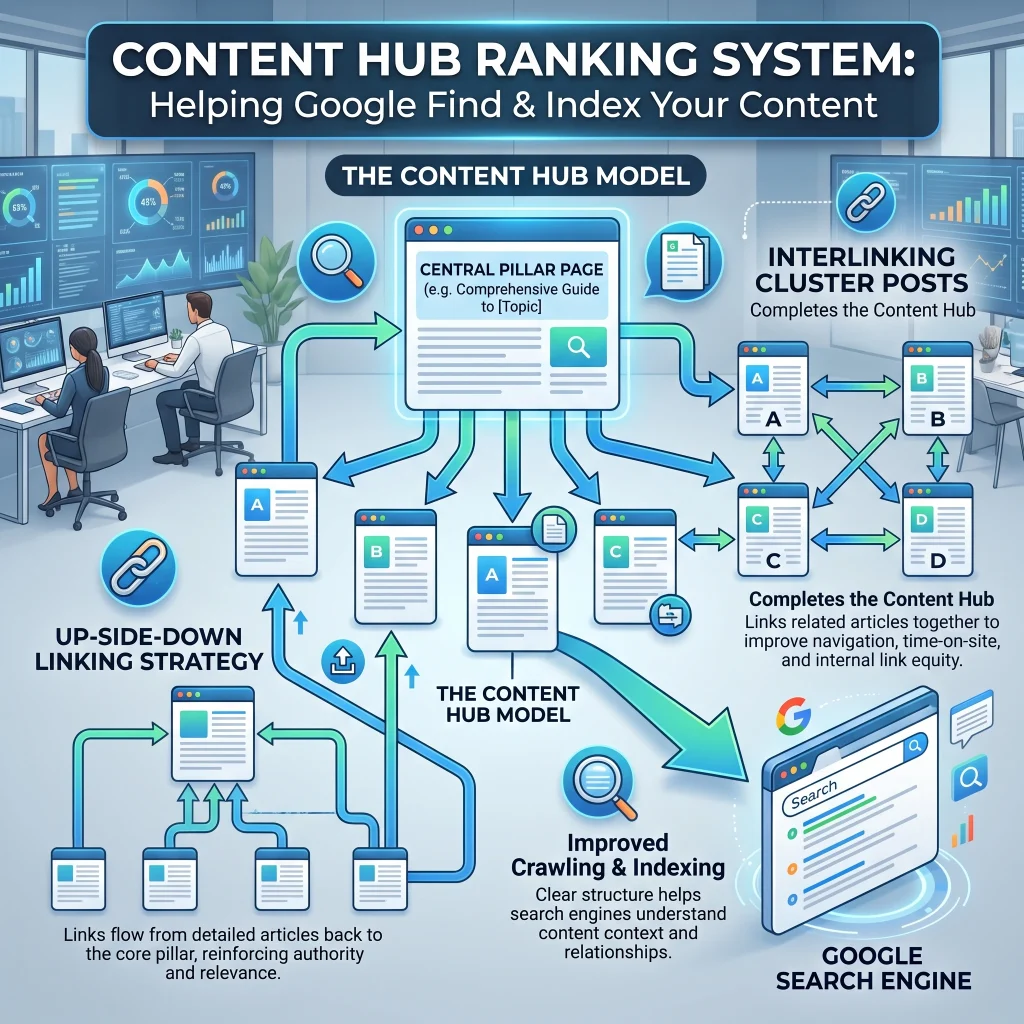
This is how you stop publishing random posts that never build momentum.
A content hub system helps search engines understand what your site is about and how your content connects.
It interlinks your posts into a single, connected structure, perfect for 2026 and beyond.
This also helps readers move naturally from one page to the next, rather than landing on a single post and leaving.
Understanding The Up/Side/Down Linking Strategy
Up (Parent Hub / Main Category): your parent hub is the main page for the topic.
The page that gives it a clear home on your site.
It serves as the central guide, showing that your content is part of a larger, organized system rather than a bunch of disconnected articles.
Side (Sub-Hub Category): Your side links connect the post to closely related topics.
They help search engines understand the broader context of your content, and help readers discover other useful pages that match what they’re already interested in.
Down (Posts Inside Categories): Your down links point readers to the next logical step.
The supporting posts that go deeper into specific parts of the topic.
Someone reading a broad SEO post might next want a checklist, a beginner’s guide, or a deeper breakdown of one strategy.
The goal is simple: build one strong main page, support it with related content, and make the path easy to follow.
That structure keeps readers on your site longer and makes your authority clearer to search engines.
What Is SEO In 2026: FAQ
What is SEO in 2026?
SEO in 2026 is the process of helping your content get discovered through modern search by matching intent, answering questions clearly, building trust, and making your pages easy for both users and search systems to understand.
Is SEO still worth it in 2026?
Yes, SEO is still worth it in 2026, but it works differently than it used to. Old-school tactics alone are not enough. Strong structure, clear answers, helpful content, internal linking, and trust signals matter more now.
What is the difference between SEO, GEO, and AEO?
SEO helps your content rank in search results, GEO helps your content get understood and pulled into AI-generated answers, and AEO helps your page become the best direct answer to a specific question. In 2026, strong pages usually combine all three.
Does SEO still matter if AI answers are taking clicks?
Yes, SEO still matters because your content still needs to be found, trusted, and understood. AI answers may reduce some clicks, but strong SEO also helps your content become part of that visibility instead of getting left out.
What should every SEO page include in 2026?
A strong SEO page in 2026 should include a direct answer near the top, question-based headings, clear structure, internal links, updated information, trust signals, and useful FAQ coverage that matches what readers are actually trying to find.
Is schema important for SEO in 2026?
Schema is important because it helps search engines understand your page more clearly. It is not a shortcut to rankings, but it can support better structure, clearer context, and richer visibility when used where it actually fits.
🏁 The Bottom Line
SEO in 2026 isn’t dead — lazy SEO is. Search is now multi-platform and AI-influenced, and the winners are the sites that match intent, answer fast, structure clean, and prove they’re real. Master the SEO foundation in this guide, then layer on GEO and AEO, and your content stops chasing algorithms and starts compounding.
Want the step-by-step “do this next” stuff — on-page, internal linking, and building clusters the right way? Work through the hub like a system.
🧭 Explore The Traffic & SEO Hub →💬 Your Turn — Let’s Chat!
Do you have any questions about SEO, GEO, or AEO in 2026? Drop them below — I personally reply to every comment, and your question might even shape Part 2 and Part 3 of this series.
Until next time — stay focused, stay real.
To your success,
– Scott Newkirk
📚 The SEO → GEO → AEO Series
Ready for Part 2?
You’ve got the SEO foundation. Now learn how to get your content cited inside AI answers — ChatGPT, Perplexity, and Google’s AI Overviews.
Continue to Part 2: Generative Engine Optimization →Keep Reading: Put This Into Practice
Now that you know how SEO works in 2026, these guides show you where to aim it.
👉 How To Drive Traffic In 2026: Step-by-Step Beyond Google
👉 How To Succeed In Affiliate Marketing In 2026 (7-Step Playbook)
👉 Affiliate Marketing In 2026: What’s Changed & How To Get Started