
Disclosure: Some links in this post are affiliate links. If you sign up through them, I may earn a commission at no extra cost to you. I only recommend platforms and tools I personally use.
What does YouGov do? YouGov is a global research and data company that pays members to share their opinions through surveys, polls, and passive data programs. Points convert to real money — 100,000 points equals $100, redeemable by bank transfer, PayPal, or gift cards. I’ve been a member for 6 years, completed 208 surveys, earned 359,000+ points, and cashed out real money multiple times. This review is built on those receipts.
Hey, it’s Scott! 👋
Six years ago, I signed up for YouGov to see if it was another survey-site letdown or something real.
Six years, 208 surveys, 359,210 points, and multiple $100 cash-outs later — including one that hit my bank account just last week — I’ve got a real answer for you.
Not a rewritten FAQ page. Actual receipts, actual numbers, and the parts most reviews never mention — including the passive earning layer that quietly made up close to HALF my lifetime points.
Let’s get into it.
🚀 Jump to any section 👇
1🤝 Why You Can Trust This Review
2🌍 What Is YouGov & What Does It Do?
4💰 How Much I’ve Actually Earned
5🔌 The Passive Layer Nobody Talks About
6🎯 How To Use YouGov Effectively
Why You Can Trust This Review
Most YouGov reviews are written by people who signed up last month to write the review.
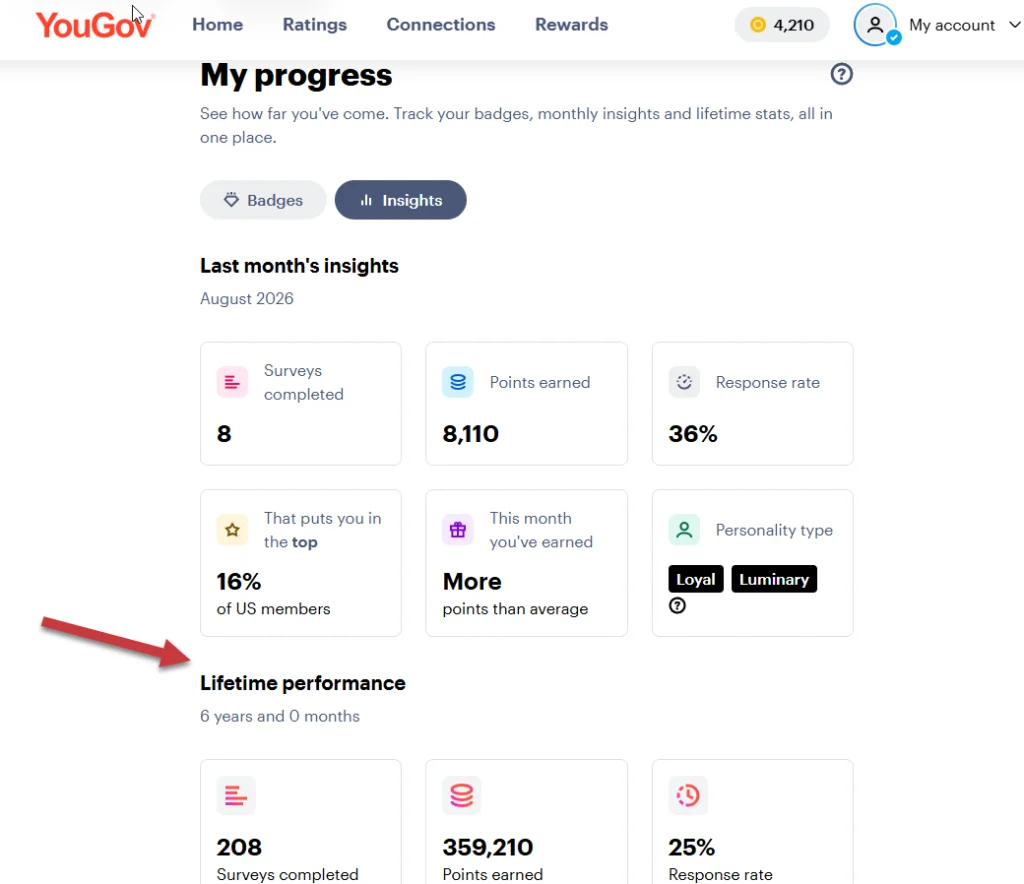
Here’s my track record instead, straight from my dashboard:
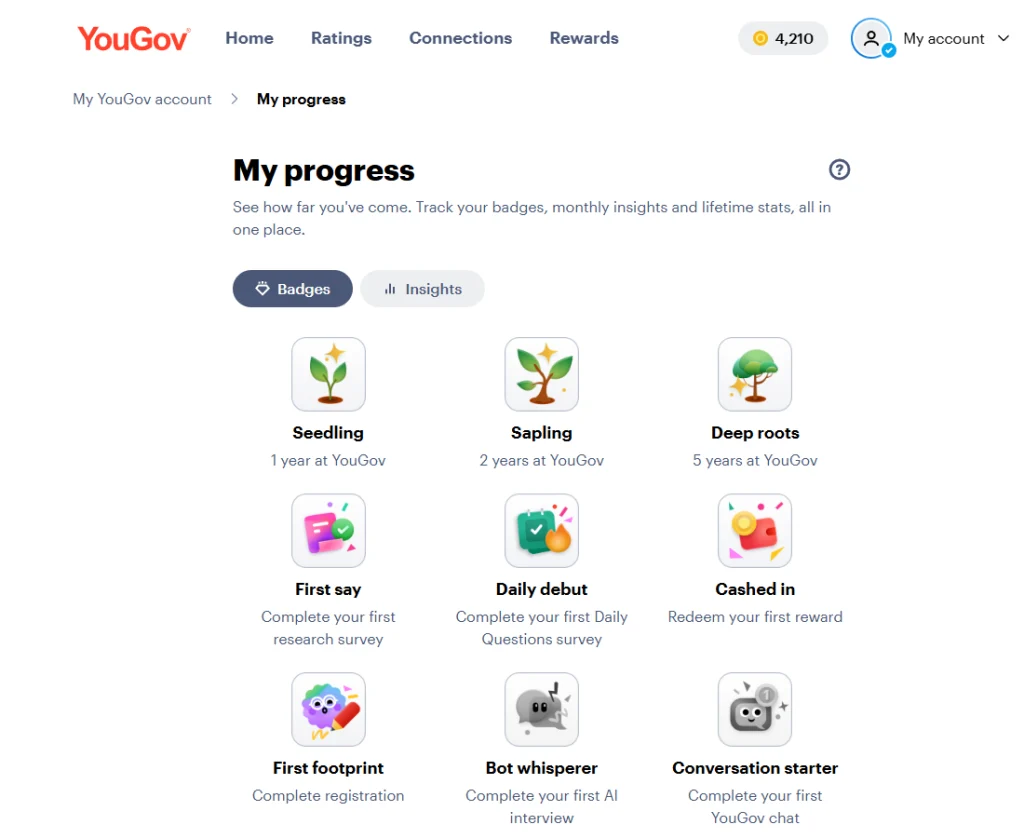
- 6 years as a member (my “Deep Roots” badge says hi)
- 208 surveys completed
- 359,210 lifetime points earned — roughly $359 worth
- Multiple $100 cash-outs redeemed — the latest hit my bank account last week
- Top 16% of US members last month — on about 2 surveys a week
One more thing worth saying up front: as of publishing this, I don’t earn a commission if you sign up for YouGov.
There’s no angle here.
This is just what six years on the platform actually looks like.
What Is YouGov & What Does It Do?
YouGov isn’t a random survey site; it’s one of the biggest research and data companies in the world.
Publicly traded on the London Stock Exchange, founded in 2000.
With roughly 29 million registered members worldwide.
You’ve almost certainly seen their work without realizing it.
Those opinion polls quoted in news articles,” according to a YouGov poll…”- that’s them.
Here’s what YouGov does in plain English: brands, media outlets, and researchers pay YouGov for insight into what real people think, watch, and buy.
YouGov gets those answers from members like you and me — and pays us points for providing them.
Your opinions literally become the data behind headlines and business decisions.
That’s the trade — and it’s one of the 7 real ways to get paid for your opinion that I’ve personally tested.
And it matters for one big reason: because YouGov’s real business is research (not selling you stuff).
The surveys feel more legitimate than most of the survey-site world.
Real topics, real polls, an actual company behind it, not a spam funnel wearing a survey costume.
It also passes the first test I run on every survey site, straight from the FTC’s scam guidance: legit platforms never ask YOU to pay.
YouGov is free, full stop.
How YouGov Works (Points, Surveys & Rewards)
The system is simple:
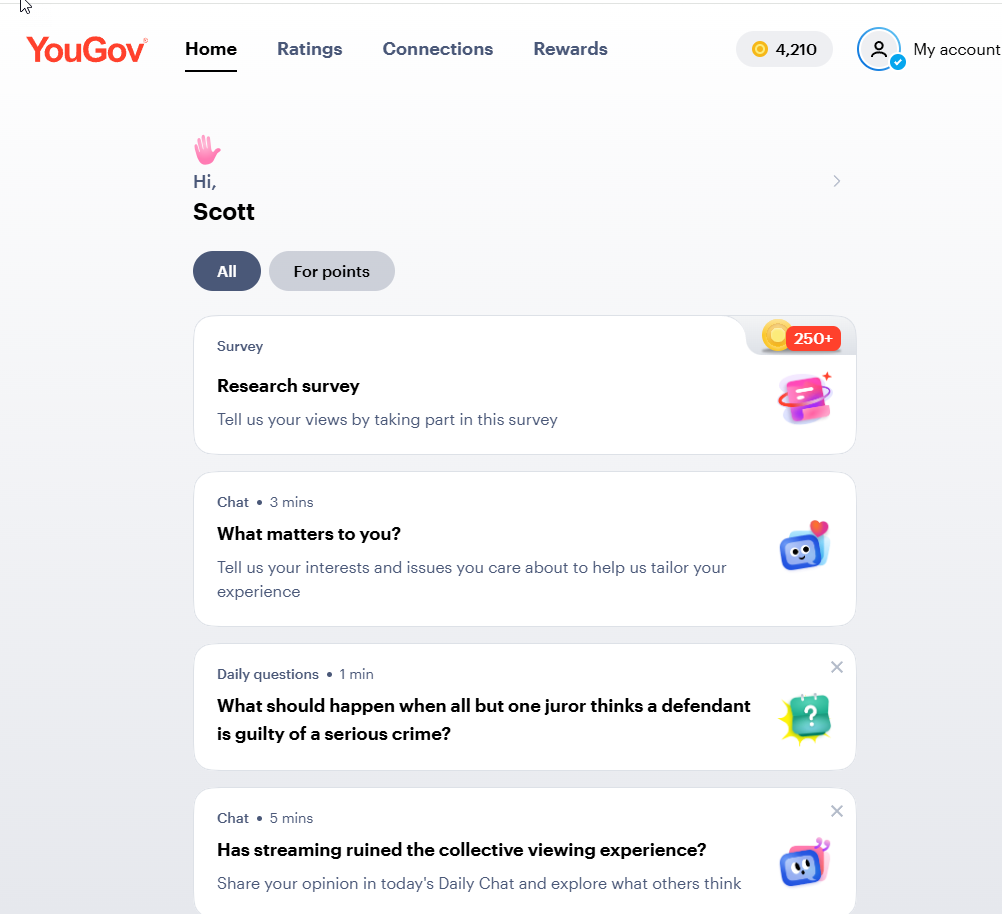
- Sign up for free and fill out your profile
- Answer surveys and polls when they land — plus optional daily questions, AI interviews, and chats
- Earn points for each one
- Redeem points for cash or gift cards once you hit a threshold
The math that actually matters: 100,000 points = $100. So every 1,000 points is worth about a dollar.
My surveys have averaged roughly 1,000–1,700 points each — call it $1 to $1.70 per survey, with some paying more. Last month I did 8 surveys and earned 8,110 points.
And here’s the detail that separates YouGov from almost every other panel I’ve used: you’ll NEVER be screened out of a survey you’re invited to.
If it lands in your queue, it’s yours — you complete it, you get paid. No answering five minutes of screener questions just to get booted with nothing.
If you’ve spent any time on other survey panels, you know exactly how big that is (Unlock, I’m looking at you). It’s the single most respectful thing a survey site can do with your time — and the only other panel I’ve used that gets this right is PaidViewpoint, my top pick.
Let me be straight with you: survey points alone are a slow drip.
If that were the whole story, this review would be shorter.
But it’s not the whole story — and the next two sections are where YouGov actually gets interesting.
How Much I’ve Actually Earned (Real Numbers)
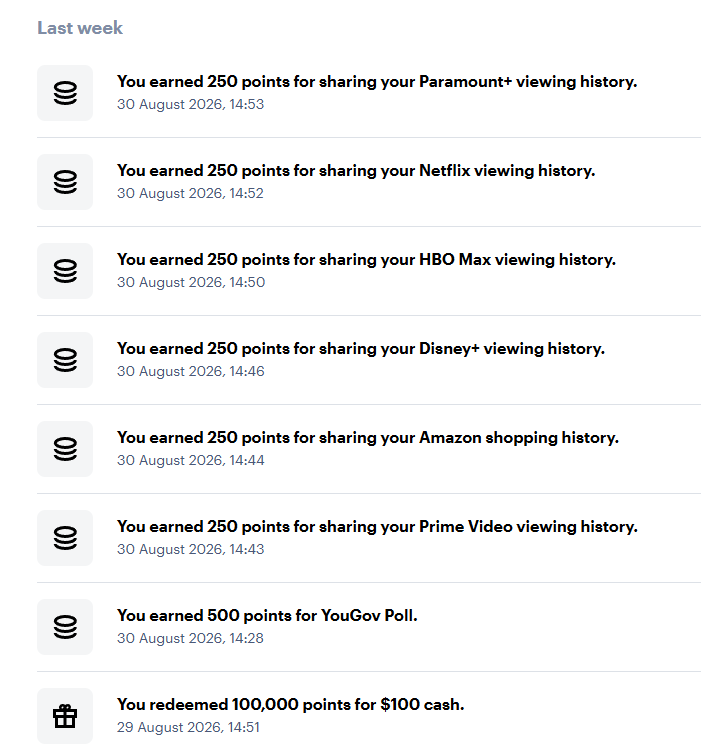
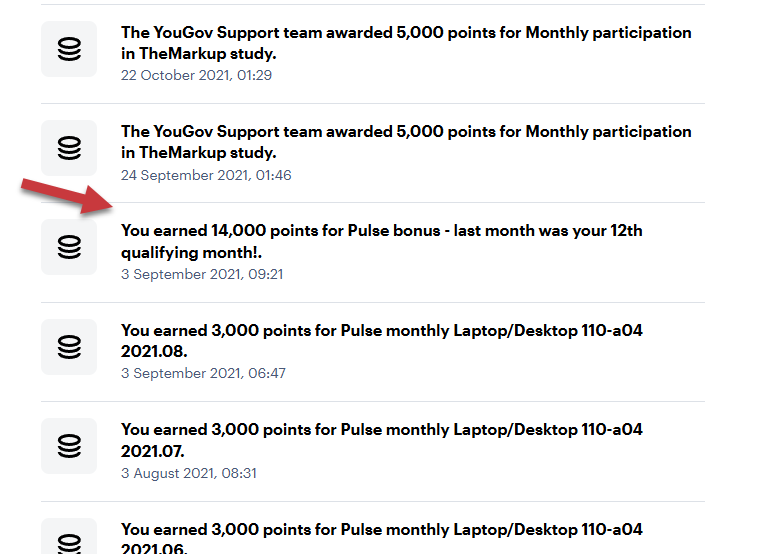
Here’s my six-year ledger, no rounding up:
- 359,210 lifetime points earned — about $359 in value
- Multiple $100 cash rewards redeemed over the years — my third or fourth just landed
- Some big single hits along the way — including a 14,000-point bonus (that’s $14 in one drop) just for staying consistent in one of their programs
- Monthly study bonuses of 5,000 points ($5/month) during research partnerships I qualified for
Important honesty checkpoint: that’s $359 over six years — with a two-year break in the middle where I earned nothing. This is side-drip money, not rent money.
Although it did pay my electric bill this month.
But here’s the number that reframes everything: I hit the top 16% of all US members last month on about two surveys a week.
The effort bar is LOW. This isn’t a grind platform — it’s an “answer a few questions while the coffee brews” platform.
And close to half of my lifetime points didn’t come from surveys at all.
The Passive Layer Nobody Talks About
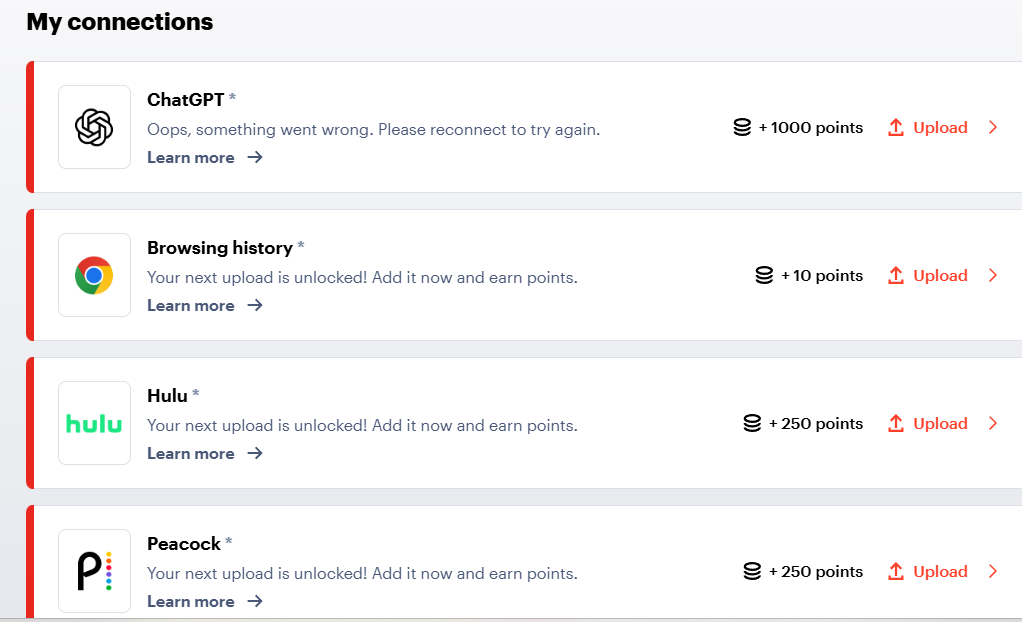
This is the part every other YouGov review skips — and it’s where close to HALF of my 359K points came from.
YouGov pays for passive data sharing, in three flavors:
1) Connections — Get Paid For What You Already Watch
You connect the platforms you already use — Netflix, Hulu, Disney+, Paramount+, Peacock, Amazon shopping, Steam, ChatGPT, even your bank and Google browsing — and YouGov pays you points for sharing that history.
Most connections pay around 250 points a week, each. Stack a few streaming services you were watching anyway, and that’s steady weekly income for literally zero additional effort.
2) Pulse — The Browsing Tracker

Pulse is their optional device program — install it, and it pays a monthly bonus (mine paid 3,000 points a month), plus loyalty bonuses for consistency.
My 12th qualifying month paid a 14,000-point bonus — fourteen bucks for showing up.
3) Research Studies — The Recurring Bonuses
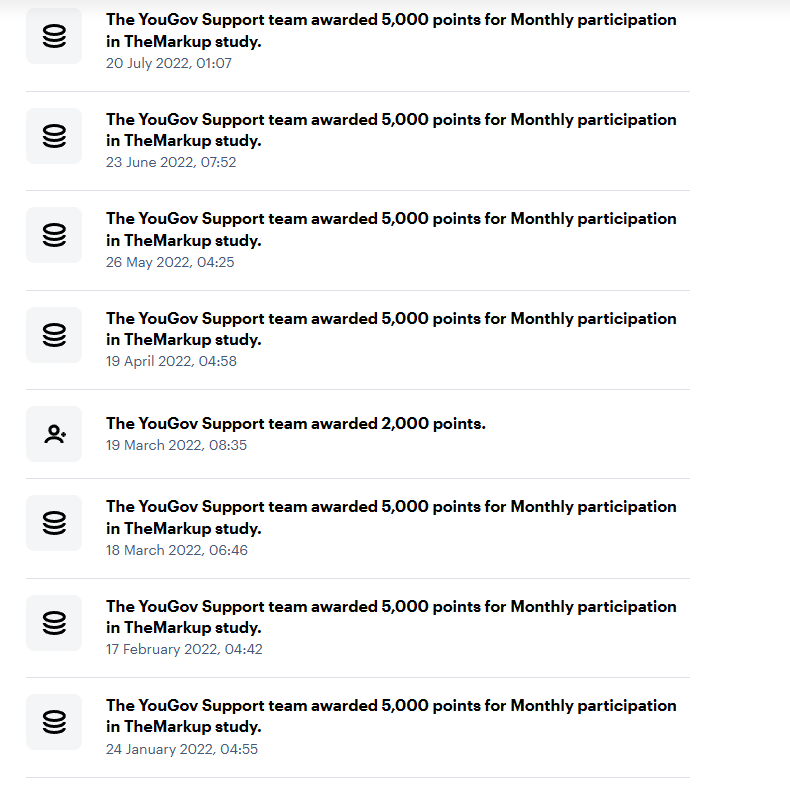
Over the years, I qualified for research partnerships that paid 5,000 points a month, every month, for staying enrolled.
That’s $5/month for existing.
Now, the honest part, because this review doesn’t dodge it: the passive layer is a data trade.
You are selling your watch history, your shopping data, your browsing patterns.
YouGov is transparent about it, everything’s opt-in, and you choose exactly which connections to enable — but let’s call it what it is.
Some people are completely fine trading Netflix history for ~$1/week per platform.
Some people aren’t.
Both are valid; you just deserve to make that call with clear eyes, which is more than most reviews give you.
My take after six years: I picked the connections I was comfortable with, skipped the ones I wasn’t, and the passive layer roughly DOUBLED what surveys alone would have earned me.
Want to try YouGov for yourself?
It’s free to join, the surveys are legit, and the passive layer stacks while you live your life. Six years in, it’s still on my phone.
📊 Join YouGov Free →How To Use YouGov Effectively (6 Years Of Lessons)
If you’re going to do this, do it the smart way. (And if survey sites are brand new to you, my guide on how to make money with online surveys covers the fundamentals that apply to every panel, not just this one.)
Stack the passive layer FIRST. Connect the platforms you’re comfortable sharing on day one; that’s the engine that runs while you sleep.
Surveys are the bonus on top, not the other way around.
Complete your profile fully. Better profile = more survey matches = fewer screen-outs.
Do the quick dailies when they appear. Daily questions, chats, and AI interviews are small points, but they keep your account active and your response rate healthy.
Treat it as coffee-break money. Two surveys a week put me in the top 16% of US members. You don’t need to grind this — you need to be consistent.
Cash out when you hit the threshold. Don’t let six figures of points sit around — redeem and bank it.
Money in your account beats points in theirs.
Getting Paid: Redemption Options & How To Cash Out
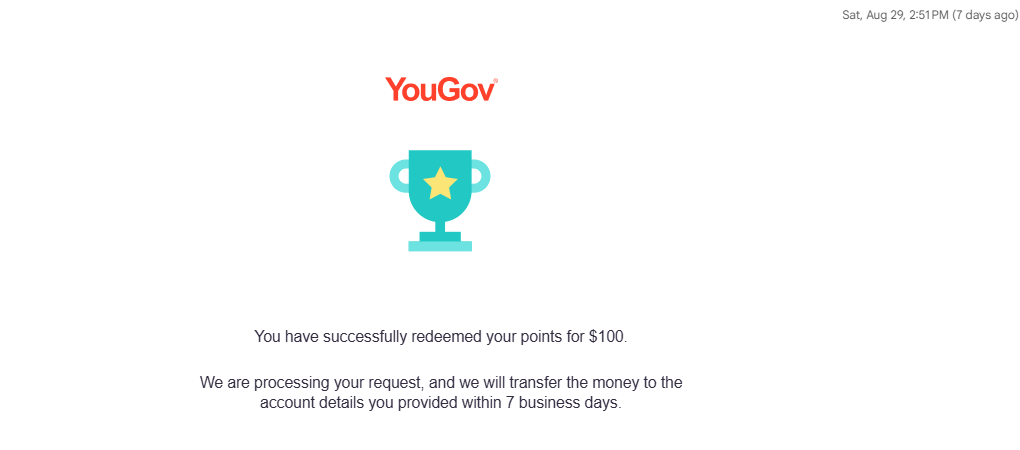

Here’s my real redemption experience, including last week’s:
The minimum payout is just $15 — one of the friendlier thresholds in the survey world.
I personally save up for the $100 cash reward (100,000 points), but that’s my preference.
It’s not a requirement; you can redeem way earlier and way more often if you’d like.
Bank transfer: about 5 days. I cashed out on a Saturday; the deposit landed Thursday. It works, just not fast.
PayPal: much quicker — in my experience, closer to 24–48 hours.
If speed matters, PayPal’s the move.
Gift cards — a long list of retailer options if you’d rather skip cash entirely.
One quirk worth knowing: my bank transfer arrived with no confirmation email at all — the money just quietly showed up. If you go the bank route, watch your account, not your inbox.
Your Redemption Options (What You Can Actually Get)
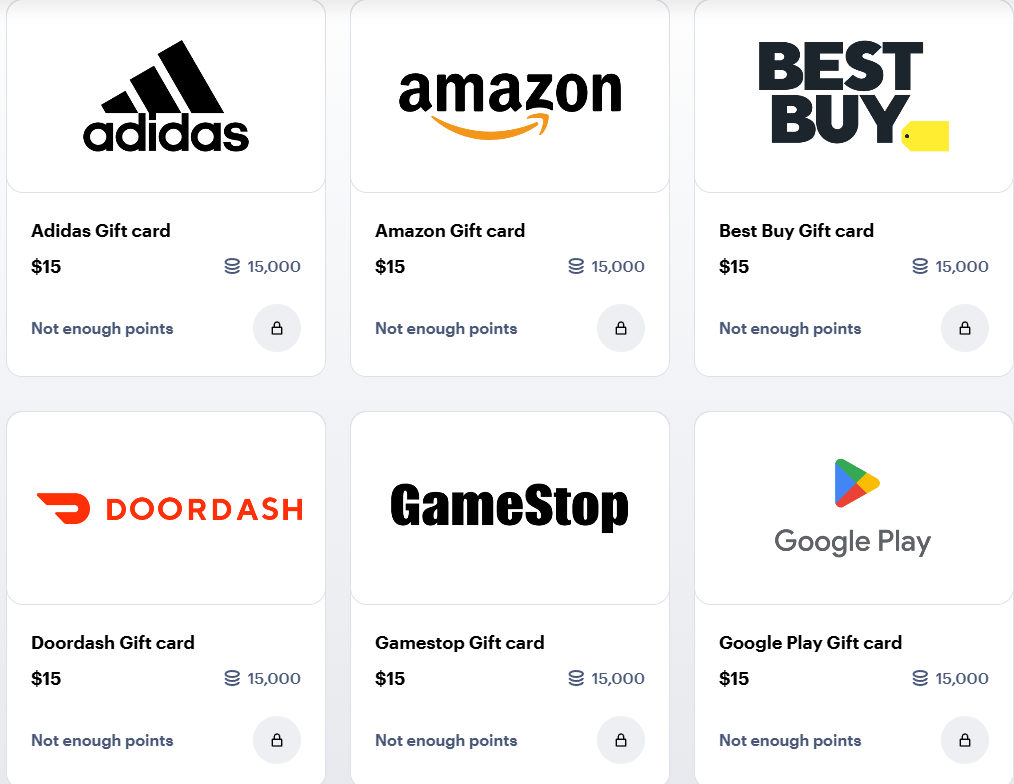
Once you cross the $15 line, here’s the menu US members get:
- Cash via PayPal — the fastest route in my experience, usually 24–48 hours
- Cash via bank transfer — direct deposit to your account, about 5 days for me, and it arrives silently
- Gift cards — Amazon plus a long rotating list of retailers, if you’d rather spend than bank
- Whatever else the Rewards tab is offering — options rotate and vary by country, so peek at the current menu before you decide
The points value is identical no matter which you pick — 1,000 points is a dollar whether it’s PayPal, bank, or a gift card. Choose by convenience, not by “value.”
How To Cash Out Once You Hit $15 (Step By Step)
It takes about two minutes:
- Open the Rewards tab — it’s right in the top navigation of your YouGov account, next to Connections.
- Pick your reward type — cash (PayPal or bank transfer) or a gift card.
- Choose your amount — anything from the $15 minimum on up. The bigger tiers (like the $100 I go for) just take longer to reach; there’s no bonus for waiting.
- Enter your payout details — your PayPal email or bank account info. First time only; it saves for next time.
- Confirm — then watch the RIGHT place. PayPal shows up in your PayPal balance within a day or two. Bank transfers take about a business week and land with no email, so check your bank, not your inbox.
Your first redemption also unlocks the “Cashed In” badge on your progress page — a small thing, but it’s a nice “yep, this is real” moment the first time you see it.
YouGov Pros & Cons (The Honest List)
✅ Pros
Legit global research company
Real cash payouts (receipts to prove it)
NO screen-outs — invited surveys are yours, period
The passive Connections/Pulse layer
Interesting, real-topic surveys
Low effort bar (top 16% on 2/week)
Multiple payout options + low $15 minimum
Free to join
❌ Cons
Reaching my preferred $100 cash-out takes months without the passive layer
Surveys alone are a drip (~$1–2 each)
Bank transfers take ~5 days, no email
Passive layer = trading your data
Survey volume varies by profile
This is pocket money, not income
And don’t just take my word for it — SurveyPolice’s member reviews of YouGov are worth a skim to see what other panelists report. Fun fact: their own write-up confirms the no-screen-out experience I described above. Transparency beats hype, always.
How YouGov Stacks Up: My 6 Survey Panels, Ranked Honestly
Ranked from my own paid experience. Affiliate links marked — I may earn a commission at no cost to you.
★ My Top Pick
PaidViewpoint
Member since 2016, paid multiple times • Never screens you out • PayPal cash
Join PaidViewpoint →MyPoints
122K lifetime points, ~$768 • Surveys + shopping cash back + offers (a $250 Uber Eats bonus, receipt inside) • My rating: 4.5/5 — Read my review
Join MyPoints →This Review
YouGov
6 years, 208 surveys, multiple $100 cash-outs paid to me • The polls behind the headlines + a real passive layer • My rating: 4.5/5 — full verdict on this page
Branded Surveys
Paid me multiple times via PayPal • Same survey boredom, but extra ways to earn beyond surveys • Low payout threshold
Read my reviewSurvey Junkie
One of the biggest US panels • Points-per-minute transparency • My rating: 4/5 — Read my review
Unlock Surveys
Legit company • Constant screen-outs, penny-level surveys, slow $25 grind • My rating: 2/5 — not recommended
Read my reviewYouGov FAQ
What is YouGov and how does it work?
YouGov is a global research and data company that pays members to share opinions through surveys, polls, and optional passive data programs. You earn points for participating — 100,000 points equals $100 — and redeem them for cash via bank transfer or PayPal, or for gift cards.
Is YouGov legit?
Yes. YouGov is a legitimate, publicly known research company whose polls are regularly cited in major news coverage. I’ve been a member for six years, completed 208 surveys, and redeemed multiple $100 cash rewards — including a bank transfer that arrived within about five days.
How much does YouGov pay per survey?
In my six years of data, surveys average roughly 1,000 to 1,700 points each — about $1 to $1.70 — with occasional higher-paying studies. The bigger earning opportunity is the passive layer: platform connections around 250 points weekly each, plus monthly program bonuses.
What are the benefits of using YouGov?
Real cash payouts from a legitimate research company, no screen-outs on invited surveys, interesting topics, a low effort bar, a $15 minimum payout with multiple redemption options, and a passive earning layer through platform connections that accumulates points without active work.
How do I sign up for YouGov?
Signing up is free — create an account, complete your profile so surveys can match you, and connect any platforms you’re comfortable sharing to activate passive earning. Surveys and daily questions start appearing once your profile is set up.
Is YouGov worth it in 2026?
Worth it for coffee-break money and passive point stacking — yes. As real income — no. Expect a slow, steady drip that adds up to periodic $100 cash-outs, especially if you enable the passive layer. Treat it as a low-effort side stream, not a paycheck.
🏁 The Bottom Line
My verdict after six years: ⭐ 4.5 out of 5 — Recommended. Is YouGov legit? Yes — six years, 208 surveys, 359K points, and multiple $100 cash-outs say so. Is it life-changing money? Not even close, and any review claiming otherwise is selling you something. It’s a legitimate slow drip: interesting surveys, a genuinely underrated passive layer, and real cash that shows up when you put in coffee-break effort. Perfect for “I want an extra $100 showing up a few times a year without thinking about it.”
And when you’re ready for more than pocket money — the kind of income that took me to $100K+ — that’s a different game entirely, and it’s what the rest of this site teaches.
📊 Try YouGov Free →💬 Your Turn — Let’s Chat!
Have you tried YouGov? How’s your points balance looking — and did you know about the Connections layer? Drop it in the comments — I personally reply to every one.
Until next time — stay focused, stay real.
To your success,
– Scott Newkirk
Keep Reading: The Survey Cluster
Every panel I’ve actually been paid by, ranked and reviewed honestly.
👉 PaidViewpoint Review 2026: My 10-Year Experience (Proof Inside)
👉 7 Real Ways To Get Paid For Your Opinion In 2026 (I’ve Tried 4)
👉 How To Make Money With Online Surveys: Details Revealed Inside